Chinese History 历 史
Most countries can look back at a few hundred years of continuous recorded history; China looks back at thousands of years. From earliest times an accurate account of events has been treasured by the Chinese, this is embodied in the character 史 history ’ which also has the meaning ‘impartial’ . Chinese people know their heritage well and have a long tradition of revering their ancestors . A good knowledge of Chinese history is essential to understanding and relating to its people.
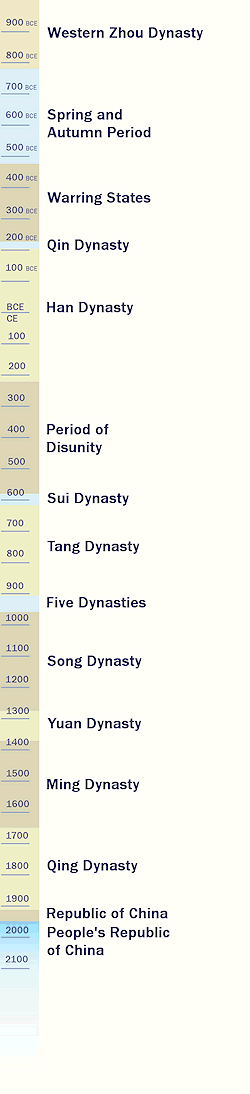
We include pages on all the main dynasties (you can click on the time chart) as well as significant events in Chinese history, up to the foundation of the Republic separate section Taiping Rebellion railways Imperial system Hanlin Academy Imperial officials kowtow Mandate of Heaven Opium Wars Early contacts with Britain 18th century UK-China contacts Leibniz Treaty port system Chinoiserie Lay-Osborn debacle General Charles ‘Chinese’ Gordon Chinese coolies
Click on the time chart on the left to go to a particular time period.
Chinese money As in so many other things, China was the first to introduce paper currency and has had a standard coinage for thousands of years. Read more…
The Qin Dynasty The brief spell of rule by the Qin (only 15 years) defined much of what we now about China. The totalitarian rule of Qin Shihuangdi set common standards for all sorts of things across his new vast empire including measurements and the Chinese script. Read more…
Spirit Ways to Imperial Tombs For 2,000 years illustrious people had an elaborate underground burial tomb. Although many tombs have been looted over the ages, the spirit ways or sacred ways with rows of stone sculptures have often survived. Read more…
Foreigners in China China was exploited by foreign powers from the end of the Qing dynasty to the foundation of the PRC in 1949. The establishment of foreign enclaves within most Chinese cities one hundred years ago led to many frictions with the foreign powers, particularly Britain. The treaty port system forcibly opened up cities to foreign trade in late Qing dynasty China. Read more…
Foot binding The custom of binding the feet of girls from a very early age lasted from the Sui to the Qing dynasty and was at times inflicted on half of all girls. It was seen as a badge of wealth of a household because it implied that the family was rich enough to not need women to carry out physical work and kept them house-bound. Read more…
Great Inventions The four great Chinese inventions are considered to be: paper; printing ; compass and gunpowder . Other key inventions include the abacus, iron casting, pasta, silk etc.. However the production of paper and then printing must be considered the most important of these. Read more…
Qing dynasty The end of the dynastic system in China came after a very promising and prosperous start under the wise rule of the first four Manchu Emperors. Years of decline followed with the Opium Wars and Taiping Rebellion ending in the sad tale of the Emperor Puyi Read more…
Song dynasty The Song dynasty is a period of Chinese refinement and peace rather than military prowess. Great strides were taken in the creative arts and literature. Prosperity from the growing trade by sea rather than overland fueled the building of huge cities. The eventual conquest by the Mongol hordes brought the dynasty to a tragic close. Read more…
China's Ancient Script The discovery of a huge number of 'oracle bones' has greatly added to the knowledge of the origins of China's written script. It pushes back the written language to at least 3,500 years ago. Careful study of the inscriptions is still revealing information about life in Shang dynasty times. Read more…
The 13 Ming Tombs The tombs of the 13 Ming Emperors is one of the largest and most lavish burial complexes anywhere in the world. Like the Valley of the Kings in Egypt the tombs are scattered around a valley of 17 square miles but here only one tomb has been excavated and was found to be completely intact. Read more…
Relations with Taiwan - the One China Policy An exploration into the current debate about the status of Taiwan with a look into the complex history and some thoughts on the future. Read more…
Japan and China The history of the often difficult relations between China and Japan reveals a complex relationship. The Japanese occupation of China 1937-45 and continued U.S. support for Japan has led to continuing frictions between governments and peoples. Read more…
Pantheon of Chinese gods and heroes China has a rich array of heroes, gods and goddesses to draw on. Temples are full of images of people from China's long history. Often an historical figure is over time upgraded and considered an immortal. Most depictions can be identified by the objects the deity is carrying. Some are associated with Buddhism, others with Daoism and others to no particular religion at all. Read more…